


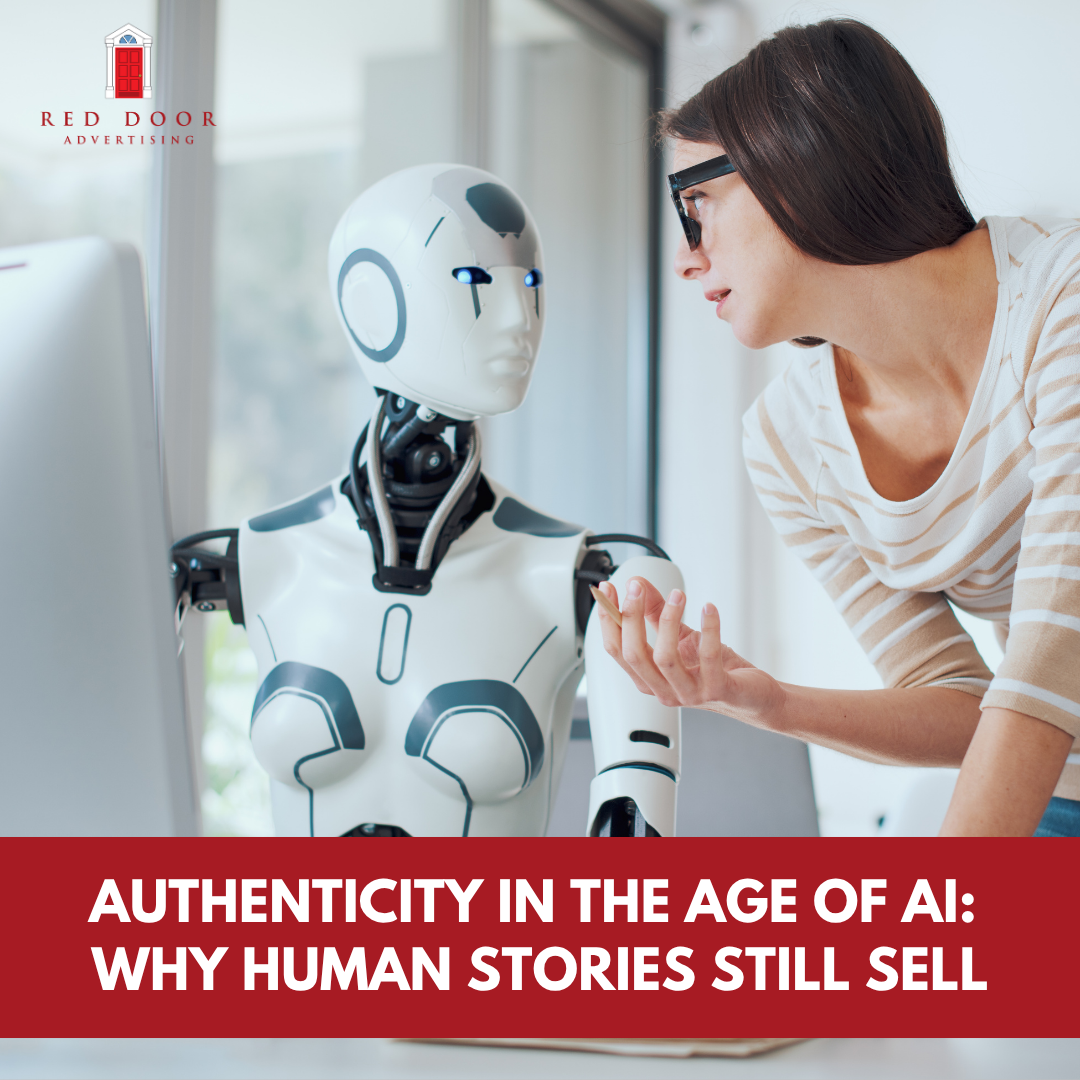
29 Sep Authenticity in the Age of AI: Why Human Stories Still Sell
AI is changing advertising fast. It writes social captions, builds visual concepts, digs through customer data, and speeds up campaign development in ways that weren’t possible a few years ago. If you’re a business owner weighing how much of your marketing should run through AI, it’s worth asking a bigger question first: what actually makes a customer stop scrolling and pay attention to your brand?
Usually, it comes down to something no algorithm can fake: a real story about real people.
Your customers want more than convenience. They want to feel like you get them. They want to know who’s behind your business, why your product exists, and what values guide the decisions you make. When so much marketing runs on autopilot, authenticity stands out. Here’s why human stories still carry advertising, and how to use AI without losing that human touch.
What Authenticity Actually Means in Advertising
Authenticity isn’t casual language or a few behind-the-scenes photos tacked onto a campaign. It’s communicating in a way that reflects who your brand is, what it stands for, and what it’s been through.
A brand built on authenticity makes promises it can keep and sounds like the same brand whether a customer is reading your website, scrolling your social feed, or talking to someone on the phone. The message matches the business.
A neighborhood restaurant might tell the story behind the family recipe that became its best-selling dish. A moving company could introduce the crew that helps families settle into a new home. A nonprofit might share how its work changed someone’s life.
Stories like these give your audience something better than a sales pitch: a reason to care.
Why Human Stories Land Harder
People connect with experiences and struggles they recognize from their own lives. A good story makes your brand feel familiar, even to someone who’s never bought a thing from you.
Picture two ads for a local home improvement company. One lists services, years in business, and a phone number. The other introduces a homeowner whose kitchen renovation made her aging mother’s life easier, and the contractor who made it happen.
Both ads say the company can do the work. Only one gives the audience a reason to remember it.
Human stories show customers not just what you offer, but why the work matters. An unfamiliar company suddenly feels relatable, and existing customers see a bit of themselves in the brand.
AI Can Write, But People Give It Meaning
AI tools are great for brainstorming, organizing ideas, drafting copy, and adapting one message for five different platforms. If your business is exploring these tools on your own, our post on key strategies for effective AI advertising digs into where the technology helps most, and where it falls short.
The catch: AI-generated content can sound generic fast when it’s missing real details, a point of view, or any real tie to your brand. A polished caption isn’t automatically a good one.
The smartest approach treats AI as an assistant, not a replacement. Real source material, customer interviews, employee stories, your company’s history, community work, honest testimonials, is what gives AI something worth shaping. The substance still must come from real experience.
Real Customer Stories Sell Better Than Ads Do
Customer stories might be the most underused tool in advertising, because they show how a product or service works in someone’s actual life.
“Great service!” is nice to hear, but it doesn’t do much. A detailed account of how your business solved a real problem does. What went wrong? How did you step in? What changed afterward?
A local accounting firm might feature a small business owner who finally feels in control of her finances. A fitness studio could share how a member built a workout routine that stuck. A community group might highlight someone who found real connection at a neighborhood event.
With permission, these stories turn into blog posts, videos, and campaign features that let prospective customers see themselves in someone else’s experience.
Show the People Behind Your Brand
Every business is made up of people with skills, personalities, and reasons for doing what they do. Sharing that makes your brand easier to remember.
Employee spotlights, founder interviews, and a look at a normal workday give customers a closer view of who’s actually delivering your product or service.
A bakery might introduce the baker who shows up before sunrise. A local business could show off the team behind a recent project, the kind of collaborative work we cover in how to turn one idea into 10 pieces of marketing content. A retailer might explain how the staff picks what goes on the shelves.
Details like these turn a logo into a group of real people, and that shapes how customers see your business.
Authenticity Isn’t About Being Perfect
A common myth: authentic marketing means airing every mistake or personal detail. It doesn’t.
Authenticity means being honest, consistent, and appropriate for your audience. A brand can stay professional and still sound human.
That might mean owning up to a challenge, explaining how a process got better, or sharing a real opinion on something that matters to your customers. The goal isn’t manufactured vulnerability. It’s to sound like an actual business instead of a press release.
The best stories tend to be simple ones: a problem solved, a relationship built, a lesson learned, a small moment from an ordinary workday.
What to Look for When an Agency Uses AI on Your Behalf
If you’re considering bringing in outside help, it’s worth knowing how a prospective partner actually works, not just what they promise. What to expect when you hire an advertising agency is a good starting point for understanding that relationship.
A few questions worth asking before you sign on:
- Do they start with real information? An agency should be gathering interviews, brand history, and firsthand accounts before writing a word of copy.
- Can they define your brand voice? They should be able to describe the tone, values, and personality that should show up in every campaign, not just hand you generic copy.
- Do they add specific details, or vague claims? Ask to see examples of past work that sound like a real business rather than a template.
- Do they review AI output closely? Someone on their team should be checking accuracy, originality, and whether the content actually matches your reality.
- Are humans still making the calls? Writers, strategists, and creative directors should be shaping the message, with AI as a tool rather than the decision maker.
- Do they put your audience first? The content should be useful or relatable to your customers, not just something to fill a calendar.
AI can help an agency produce more content, faster. Strategy is what decides which of that content is worth producing in the first place, something we cover in why consistency is the secret weapon in advertising.
The Future Needs Both
AI isn’t going anywhere, and it offers real gains in productivity, personalization, and creative testing. Businesses that use it well will save time and money.
But tech alone doesn’t build trust with your customers. Trust comes from consistent actions, honest communication, and relationships that hold up over time.
As more brands lean on the same AI tools, the human side of your marketing becomes the differentiator. A distinctive story, a real customer experience, a voice people recognize: these are what set your business apart in a crowded market.
The future of advertising isn’t AI versus human creativity. It’s both, working together, ideally with a partner who knows how to balance them.
Authenticity is still one of the most valuable things your business can bring to its advertising. AI can help produce content faster, but human stories are what give that content meaning.
Your customers want to work with brands that understand them, reflect their values, and follow through on what they promise. Share real experiences, show the people behind your business, and choose a marketing partner who treats AI as a tool rather than a shortcut. That’s how advertising starts to feel personal instead of predictable.
In a world full of automated messages, real storytelling is still what builds lasting relationships with your customers.
For more on how to help your business succeed in today’s advertising and branding landscape, contact us at randi@reddooradvertising.com or brendan@reddooradvertising.com, or visit reddooradvertising.com.